
Last reviewed by James Vandegrift, Co-Founder — May 2026
← Back to BlogSUBSTRATES
Shower Substrates: When to Use Go Board vs. Cement Board
KV Tileworks LLC · Sanford, FL · 2026
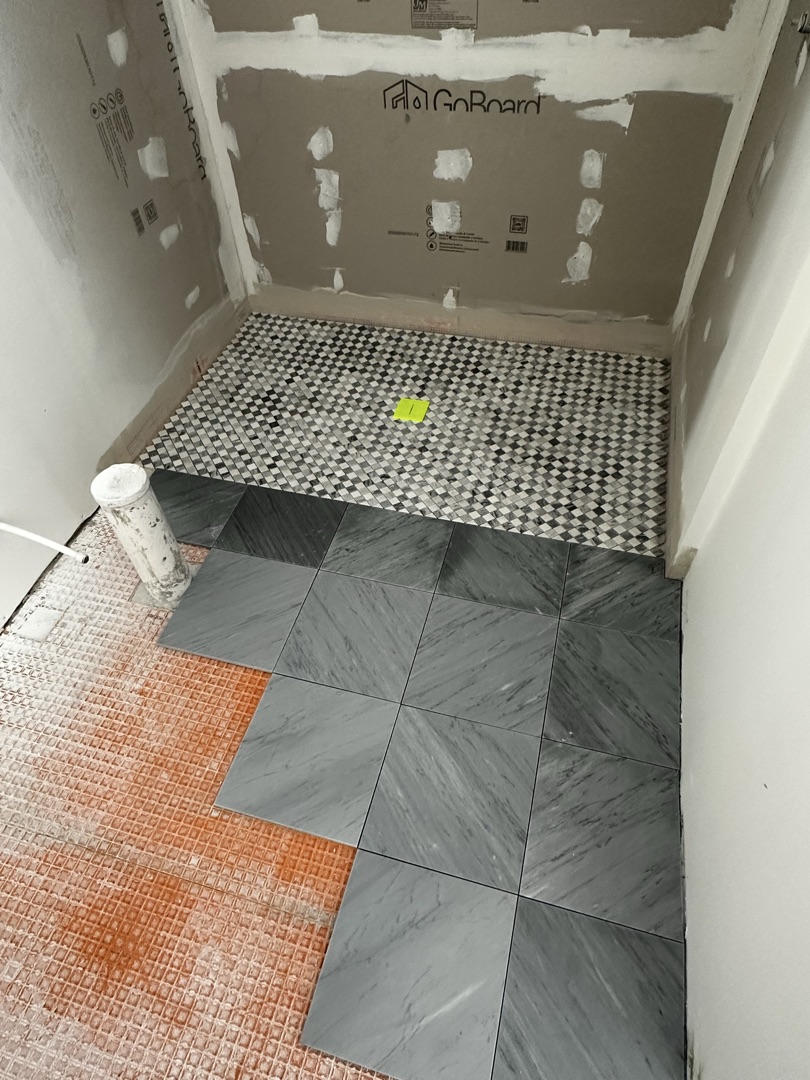
Go Board is our first choice for shower walls because it is waterproof by design, lightweight, and eliminates the need for a separate membrane on a standard alcove shower, cement board works fine but requires a full waterproofing layer on top before any tile goes up.
If you have spent any time on tile forums or talked to different contractors, you have probably heard a few different opinions on what goes behind shower tile. Cement board. Go Board. Wedi. KERDI-Board. Regular drywall with a membrane. Everyone swears by something different.
The truth is that most of these work fine when installed correctly with proper waterproofing on top. The differences come down to cost, weight, ease of cutting, how forgiving they are with water exposure, and how well they integrate with the waterproofing system you are using.
Here is how we think about it.
Traditional Cement Board (Durock, HardieBacker, Wonderboard)
Cement board has been the standard shower substrate for decades. It is a fiber-reinforced cement panel that does not rot and holds tile well. It is also heavy, hard on blades when cutting, and not actually waterproof on its own. Water passes through it freely.
That last point trips people up. Cement board is water-resistant in the sense that it will not fall apart when wet. But it absorbs water and if enough moisture reaches the framing behind it, you still get mold in the wall cavity. This is why waterproofing over cement board is not optional.
For most shower walls, cement board with a bonded KERDI membrane or liquid-applied membrane over the top is a proven, code-compliant, long-lasting system. The cement board gives you a solid, tile-bondable surface and the membrane keeps water from ever reaching it.
- Cost: lowest of the options
- Weight: heavy (a 3x5 sheet is around 50 lbs)
- Cutting: needs a carbide blade or scoring, dusty to cut
- Waterproofing: requires a separate membrane over the top
- Best use: budget-conscious builds where you are tiling over it with KERDI or a liquid membrane
Go Board (by Johns Manville)
Go Board is made by Johns Manville. It is a foam-core panel with fiberglass mesh faces. It is significantly lighter than cement board, cuts easily with a utility knife, and is waterproof through its full thickness. You can tile directly over it without a separate membrane in some applications, though adding a bonded membrane at the corners and seams is still good practice for a shower.
Go Board works with both modified and unmodified thinset, which gives more flexibility on the job. Note: if you are installing KERDI sheet waterproofing membrane over Go Board (or over any substrate), that membrane still requires unmodified thinset for bonding. Go Board as a standalone substrate accepts either thinset type.
Go Board vs. Wedi Board: These are two separate products from two separate manufacturers. Go Board is made by Johns Manville. Wedi Board is made by Wedi (a German company). They are competing foam backer products and are not interchangeable brand names. Both are waterproof foam panels, but they have different face materials, different installation requirements, and are sold separately. Make sure you know which one you have before following installation instructions.
The main trade-off with Go Board is cost. It runs considerably more per sheet than cement board. On a small shower it may not matter. On a full bathroom remodel it adds up. It is also softer than cement board, so heavy impacts can dent it. Once tile is on top, that is not an issue.
We use Go Board when schedule is tight and we need to keep installation moving quickly. The weight savings alone are noticeable when you are lifting panels overhead in a small bathroom, and the knife-cut score is much faster than a cement board setup.
Foam panels and large-format tile floors: Go Board and similar foam panel systems work well for standard mosaic or small-format tile on shower floors. For large-format tile (12x24 or larger) on a shower floor, a mud bed is a better substrate. Large tiles need a very flat, very firm base that foam cannot fully provide. Use foam panels on walls for any tile size, but consider a mud bed if your shower floor tile is 12x24 or larger.
- Cost: higher than cement board, typically 2 to 3x per sheet
- Weight: light, easy to handle solo
- Cutting: utility knife score and snap
- Waterproofing: waterproof core, but seal seams and corners regardless
- Thinset: works with modified or unmodified thinset (as a substrate)
- Best use: fast installs, ceiling applications, anywhere weight is a consideration
Wedi Board (by Wedi)
Wedi Board is made by Wedi, a German manufacturer. It is extruded polystyrene with a polymer-modified cement coating on both faces, which gives it more surface hardness than plain foam boards. Wedi has its own line of sealants, screws, and joint tape that are designed to work as a system.
The cement coating makes Wedi feel more substantial on walls, and it bonds well with most thinsets including modified. It is one of the more premium options and is popular in high-end shower builds where every material choice gets scrutinized. Like Go Board, Wedi foam panels work best with standard or small-format tile on shower floors. For large-format tile on a shower floor, a mud bed gives a firmer, more reliable base.
- Cost: among the more expensive panel options on the market
- Weight: light
- Cutting: utility knife
- Waterproofing: waterproof core, integrates with Wedi's proprietary sealant system
- Best use: high-end builds, anywhere you want one manufacturer's complete system
Schluter KERDI-Board
KERDI-Board is Schluter's foam panel designed to work as a substrate and a waterproofing component in one. It has an integrated polyethylene surface that accepts thinset and bonds directly to KERDI membrane, KERDI-BAND, and the rest of the Schluter system.
If you are already building with KERDI waterproofing, using KERDI-Board is the cleanest all-in-one approach. Everything is the same manufacturer, the same system, and the installation guide covers all the connections in one place. For niches, benches, and custom shapes, KERDI-Board is easier to work with than cement board because you can cut and shape it without heavy tools.
- Cost: similar to or slightly above Go Board
- Weight: light
- Cutting: utility knife
- Waterproofing: waterproof core, integrates directly with KERDI membrane system
- Best use: full Schluter system builds, custom niches and benches, anywhere you want one manufacturer for the whole assembly
What we actually use most: For standard shower wall builds, cement board with KERDI membrane over it is our everyday system. It is cost-effective, extremely well documented, and performs well when installed right. For ceiling applications or jobs where we are moving fast, Go Board. For niches and custom builds, KERDI-Board. There is no universal right answer.
Quick Comparison
| Material | Weight | Cut Method | Waterproof Core | Relative Cost |
|---|---|---|---|---|
| Cement Board | Heavy | Score/snap or blade | No | $ |
| Go Board (Johns Manville) | Light | Utility knife | Yes | $$$ |
| Wedi Board (Wedi) | Light | Utility knife | Yes | $$$ |
| KERDI-Board (Schluter) | Light | Utility knife | Yes | $$$ |
The Part That Actually Matters
Most shower failures we see are not caused by the wrong substrate choice. They are caused by missing waterproofing at corners, no flood test, or an unqualified installer who skipped steps. A cement board shower with properly installed KERDI will outlast a Go Board shower where the seams were not sealed.
The substrate matters. The membrane and the installation quality matter more.
If you are planning a bathroom remodel in the Sanford, Lake Mary, or Central Florida area and want to know exactly what we would spec for your project, get in touch for an estimate. We will tell you what we plan to use and why.
Frequently Asked Questions
Planning a Shower Remodel?
We spec the right substrate for every job. Estimates for Lake Mary, Sanford, Longwood, and surrounding Central Florida.
Request an Estimate